“The First Women of the Road” Traffic Policing in Sussex, 1967–1969
Written By Matt Fletcher
In 1967, under the leadership of Sir George Terry, policing in Sussex entered a period of quiet but significant change. As Chief Constable of East Sussex Police, formerly East Sussex Constabulary, Sir George was known not only for his sharp memory, he was said to remember the names of all his officers, but also for his enthusiasm for innovation. Nowhere was this more evident than in his support for the Police Traffic Division and his recognition of the growing role of women within the force.
A keen advocate of road policing, Sir George had, in 1966, introduced the first of many MG BGTs into the traffic fleet. With their arrival came another innovation, the now familiar “jam sandwich” livery, a high visibility design that would later spread across police vehicles nationwide. But Sir George’s vision extended beyond vehicles. In 1967, he made the decision to deploy two Women Police Constables, WPCs, as a dedicated traffic crew, an unprecedented step at the time.
For those selected, it represented both opportunity and challenge. Applicants were required to demonstrate their driving ability under assessment, including handling the powerful MG BGT under supervision. Two officers were chosen, Hazel Lane, née Waters, and her colleague, both at the end of their probationary periods. Their appointment marked the beginning of a pioneering chapter in Sussex policing history.
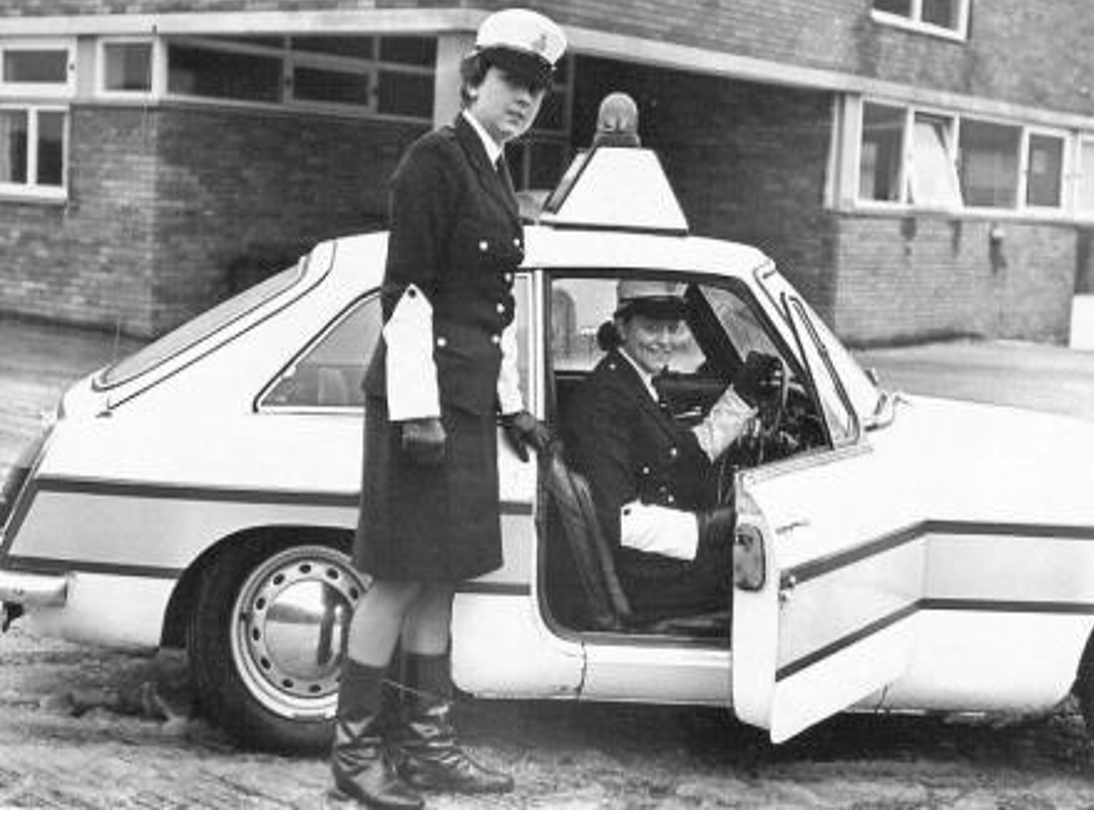
WPCs Joy Christian and Hazel Waters in January 1968
From the outset, the initiative attracted attention. The image of two women patrolling in a high performance traffic car was seen as both progressive and, at times, a novelty. For several months, the pair were deployed across the county to raise awareness and promote the work of the force. This visibility, however, brought mixed reactions. While the project generated positive publicity, some sections of the press trivialised their role, referring to them as “Traffic Dollies” or the “100 mph Petticoat Patrol.” Such labels reflected the attitudes of the time, even as the officers themselves were undertaking serious and demanding work.
Based at Lewes, the officers began their duties under the guidance of experienced male colleagues, working from the T6 traffic base. This mentorship was followed by formal training at the Kent Police Driving School in Maidstone. There, they undertook an intensive Standard Driving Course, learning advanced vehicle control and the discipline of delivering a continuous spoken commentary while driving, an essential skill in police training. Despite training in larger vehicles such as Jaguars and Humbers, both officers achieved the highest level pass available, a Class 3 standard, before returning to Sussex.
Back at Lewes, they quickly became part of the traffic team, carrying out the same duties as their male counterparts. Unlike today, police officers were typically the first to arrive at road traffic accidents and were responsible for calling emergency services. They provided first aid, managed scenes, and coordinated responses until assistance arrived. Their work extended far beyond traffic enforcement, they attended burglaries, domestic incidents, and serious emergencies, including a firearms incident and escorting a critically ill child to hospital in Brighton.
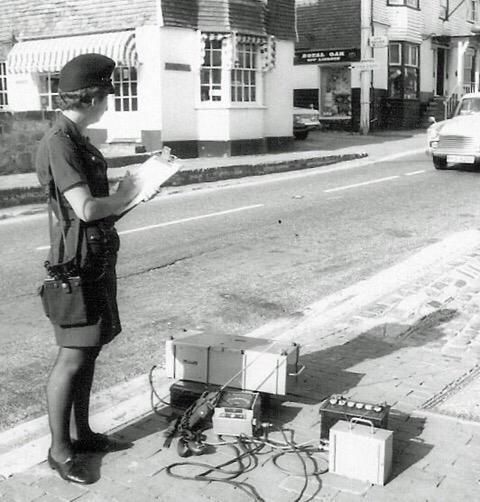
Joy Christian using an early speed radar device in 1968
In 1967, East Sussex Constabulary was renamed East Sussex Police, and in 1968 all Sussex forces were amalgamated into Sussex Constabulary. Throughout these changes, the officers continued to develop their skills. In 1969, they returned to Maidstone to undertake the Class 1 Police Driving Course. This advanced training included vehicle mechanics, skid control, and hazard awareness, all reinforced through continuous driving commentary. Both officers achieved First Class Police Driving Certificates, becoming the first women in the country to do so.
Despite carrying out identical roles, responsibilities, and risks, they were paid less than their male colleagues, a disparity that continued until the implementation of the Equal Pay Act in 1975. Nevertheless, their professional acceptance within the team was strong, and they were supported by their colleagues throughout.
Their duties also included attending a Traffic Patrol Course, covering traffic law and vehicle mechanics, with practical experience gained at Maidstone Bus Garage. This qualification enabled them to act as vehicle examiners and provide expert testimony in court. On patrol, they assisted stranded motorists, enforced speed limits using early equipment such as the PETA meter, and conducted checks on heavy goods vehicles, often encountering surprised but cooperative drivers.
The equipment they carried reflected the demands of the role, including signalling lamps, first aid supplies, fire extinguishers, cones, cameras, measuring tools, and breathalysers. Without modern technology, speed detection relied on stopwatches over measured distances, and vehicle checks required manual follow up through paper systems such as the SUSCRO index in Brighton.
Their patrol vehicles varied, from the MG BGT to Ford Lotus Cortinas and Ford Zephyrs, though the MG itself proved both innovative and impractical. While fast for its time, the weight of equipment and roof fittings reduced its performance. Officers were also responsible for maintaining their vehicles, including cleaning and basic mechanical checks.
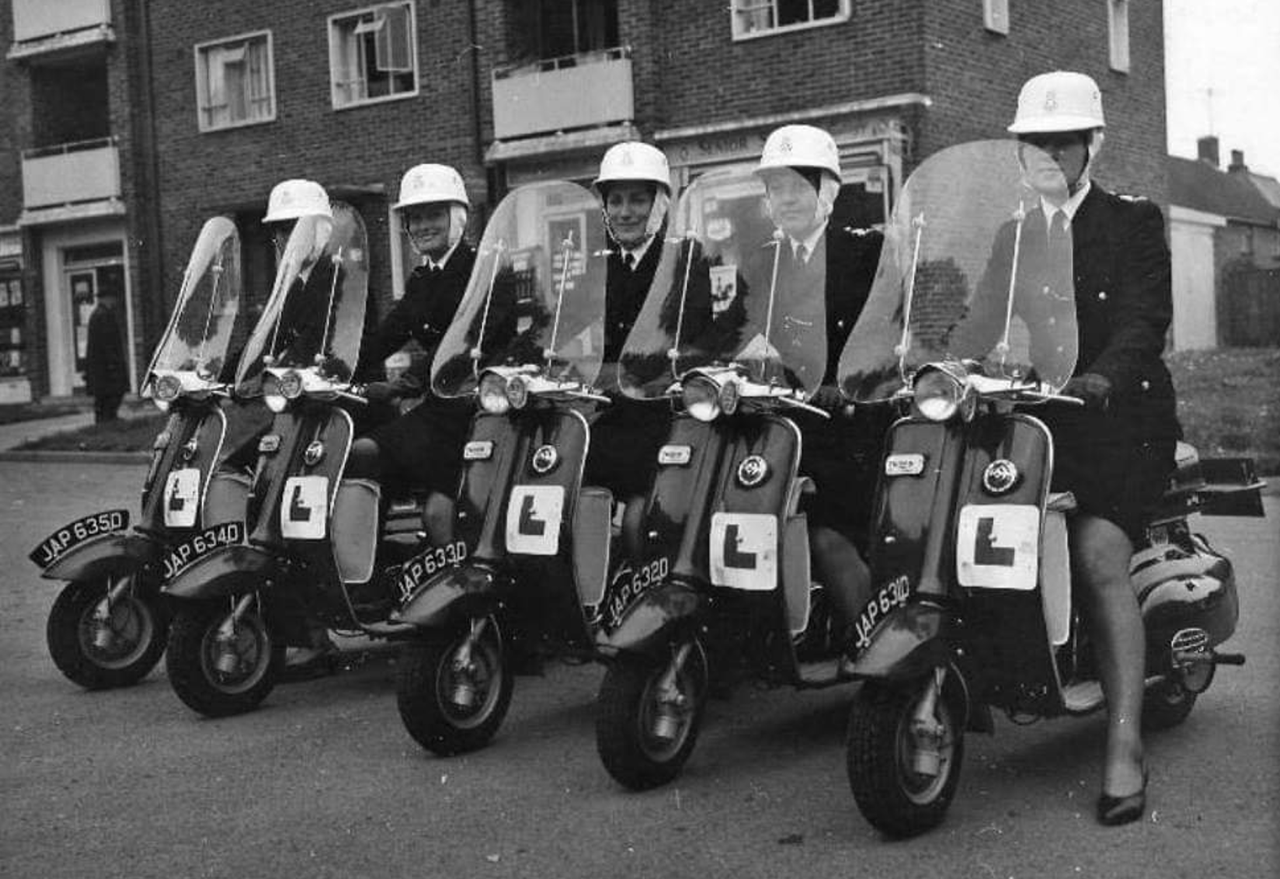
This is a group of East Sussex Constabulary Women Police Officers undergoing training on Scooters in 1966
Uniform presented its own challenges. Policewomen were still required to wear skirts, which were often unsuitable for the physical demands of traffic policing. Incidents requiring pursuit or access to difficult terrain highlighted these limitations. Even so, some aspects of their uniform, including leather boots and driving jackets, set them apart and were the envy of other officers.
The success of the pilot scheme led to further integration, with the original officers later mentoring new WPCs into traffic roles. Their work demonstrated that women could operate effectively, and equally, in all aspects of policing.
Looking back, their achievements may not have seemed extraordinary at the time, they were simply doing their job. Yet their role marked a significant shift in policing, one that continues to resonate today. The legacy of their work lives on, not only in the evolution of traffic policing, but also in the broader recognition of women’s contributions to the police service.